If Dinh Cau is often seen as a spiritual protector of fishermen at sea, Dinh Ba Thuy Long Thanh Mau is where many island residents come to pray for peace, health, and harmony in everyday life.
Located on Vo Thi Sau Street in central Duong Dong, the shrine is modest in size and easy to overlook. Travelers passing by may assume it is simply a small neighborhood temple. For local people, however, Dinh Ba carries a much deeper meaning. It has remained part of Phu Quoc’s spiritual life for generations and continues to welcome worshippers during festivals, family occasions, and ordinary days.
Beyond its religious role, Dinh Ba also reveals a side of Phu Quoc that modern attractions rarely show. It reflects the beliefs of a community shaped by the sea, the history of early island settlers. And the quiet traditions that still survive in the center of a rapidly changing town.
Who Is Thuy Long Thanh Mau?
In the folk beliefs of Phu Quoc, Thuy Long Thanh Mau is also commonly associated with Ba Kim Giao. She is respected as a female protective deity connected to rivers, water, the sea, and the peaceful life of island communities.
For generations, people living along the coast depended heavily on fishing and maritime trade. The sea provided food and income, but it also brought storms, dangerous winds, and long periods of uncertainty. In that environment, belief in a protective mother goddess became a natural part of community life.
Local residents turned to Thuy Long Thanh Mau for safety, good health, calm waters, and stability. Fishermen sometimes visited the shrine before leaving the island, while families came to pray during important moments of the year.
This belief is not unusual in southern coastal Vietnam, where many communities worship female deities associated with water, fertility, protection, and prosperity. However, the traditions surrounding Dinh Ba in Duong Dong have developed their own local character, closely connected to the history and identity of Phu Quoc.
A Coastal Belief Rooted in Southern Vietnam
People who live near forests often develop traditions connected to mountains, trees, and land. Coastal communities, by contrast, build much of their spiritual life around rivers and the sea.
For fishermen in southern Vietnam, every offshore journey once involved considerable risk. Weather forecasts were limited, communication systems were basic, and wooden boats were vulnerable to sudden storms. Spiritual beliefs offered emotional strength and a sense of protection in a life shaped by forces that could not always be controlled.
The worship of water-related goddesses can be found in coastal provinces such as Kien Giang, Ca Mau, Bac Lieu, and Ben Tre. Yet each area has its own legends, names, rituals, and interpretations.
In Phu Quoc, Thuy Long Thanh Mau is especially important because the island’s history is inseparable from the sea. Her worship reflects not only religious faith but also gratitude toward the waters that supported generations of fishermen, traders, and early settlers.
The Relationship Between Dinh Ba and Dinh Cau
Dinh Ba and Dinh Cau are often mentioned together in the spiritual traditions of Duong Dong.
The two shrines are located only a few minutes apart and are closely connected in the minds of local residents. Dinh Cau is commonly associated with protection at the river mouth and safety at sea, while Dinh Ba represents the nurturing and protective presence of the mother goddess.
Many families visit both shrines during Lunar New Year, important festivals, or personal occasions. Rather than treating them as completely separate places of worship, local people often see them as complementary parts of the same spiritual landscape.
This connection becomes most visible during the annual Dinh Cau–Dinh Ba Festival, held on the 15th and 16th days of the tenth lunar month. It is one of the most important folk festivals in Phu Quoc.
During the festival, residents offer incense, pray for peace, ask for favorable fishing conditions. And remember the early generations who settled and developed the island. Traditional ceremonies may be accompanied by lion dances, community gatherings, and forms of southern Vietnamese performance such as hat boi.
For visitors, the festival offers a rare opportunity to see how religious belief, community identity, and local history come together in Duong Dong.
A Quiet Place in the Middle of Town
Dinh Ba is usually much quieter than Dinh Cau at sunset or the nearby night market in the evening.
In the early morning or afternoon, you may see residents stop briefly to light incense before continuing with work, shopping, or family errands. These visits are often simple and unceremonious. People enter, pray quietly, and leave without drawing attention.
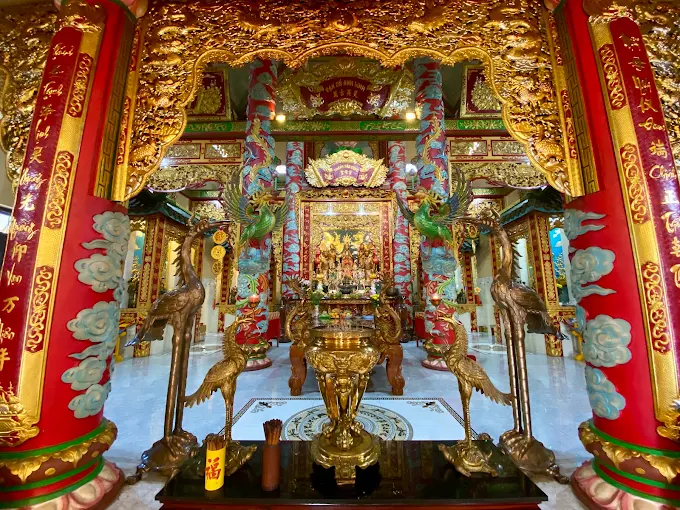
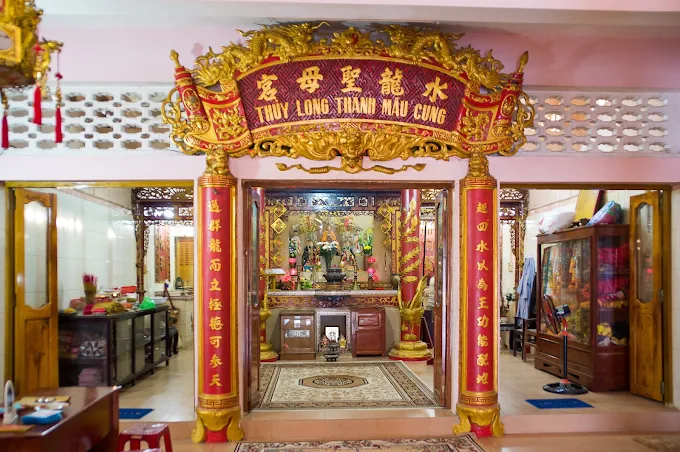
The shrine’s interior is not large, but it is carefully maintained. Incense smoke, red and gold decorations, wooden plaques, and traditional altar objects create a warm and solemn atmosphere.
For many local families, Dinh Ba is not merely a religious site. It is part of childhood memory. Parents once brought their children here during festivals, and those children later returned with families of their own.
These repeated visits help explain why a small shrine can carry such a strong emotional meaning. Its importance comes not from size or fame, but from the way it has remained woven into everyday life.
The Architecture of Dinh Ba Thuy Long Thanh Mau
Dinh Ba looks very different from the more rugged and weathered appearance of Dinh Cau.
While Dinh Cau seems closely fused with its coastal rock, Dinh Ba has the colorful appearance of a southern Vietnamese shrine restored in a traditional East Asian style. Red, yellow, green, and turquoise appear throughout the gates, roofs, columns, and decorative details.
The building has been renovated several times, so its current appearance reflects a combination of older southern temple traditions and newer decorative elements added during later restorations.
At first glance, the shrine may appear small. Once you slow down and look carefully, however, you will notice many artistic details that most visitors miss.
The Colorful Entrance Gate
The entrance is one of the most striking features of the shrine.
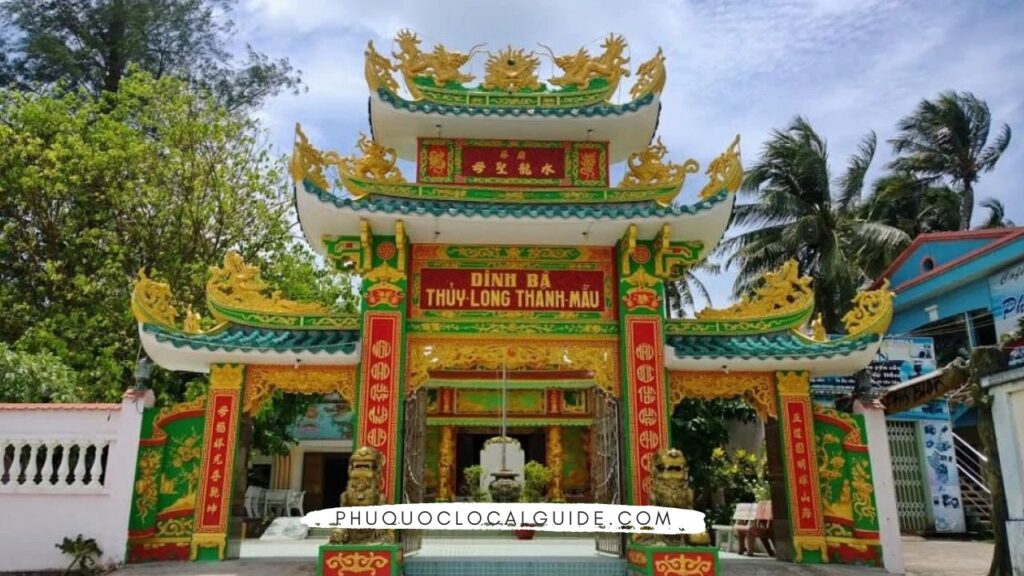
Its layered gate is decorated with dragons, clouds, floral patterns, and traditional motifs. Red and yellow create a sense of warmth and solemnity, while green and turquoise soften the overall appearance.
Above the gate and roofline, curved architectural details rise toward the sky. The familiar image of two dragons facing a moon or pearl appears on the roof, a common symbol in Vietnamese temples and communal houses.
These features were restored over time, but they continue to preserve the visual language of southern religious architecture.
The Crane Columns in Front of the Main Hall
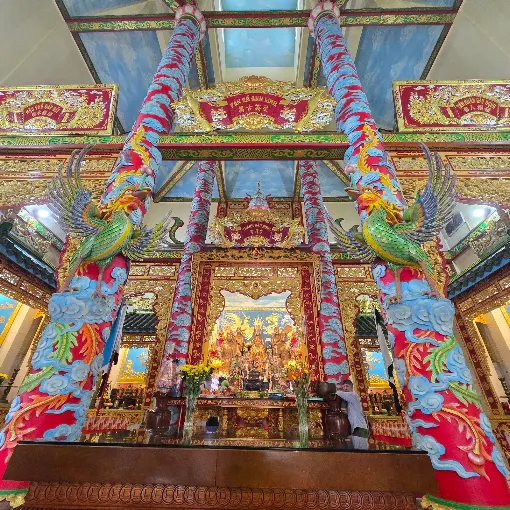
Two large columns decorated with crane figures stand near the main worship area. In East Asian symbolism, cranes are associated with longevity, spiritual purity, nobility, and a connection between the earthly and divine worlds.
They are among the most distinctive details at Dinh Ba, although many visitors overlook them when they enter only to light incense. Taking a moment to observe the columns reveals how much meaning is carried in seemingly decorative elements.
Lacquered Plaques and Chinese Couplets
Inside the main hall, red-and-gold wooden plaques and Chinese calligraphy couplets frame the altars. These objects are not only decorative. They express religious ideas, moral teachings, blessings, and respect for the deity being worshipped.
The dominant use of red and gold gives the interior a warm and ceremonial feeling. Combined with natural light and incense smoke, the colors create an atmosphere that feels separate from the busy streets outside.
Stone Mosaics and Colorful Reliefs
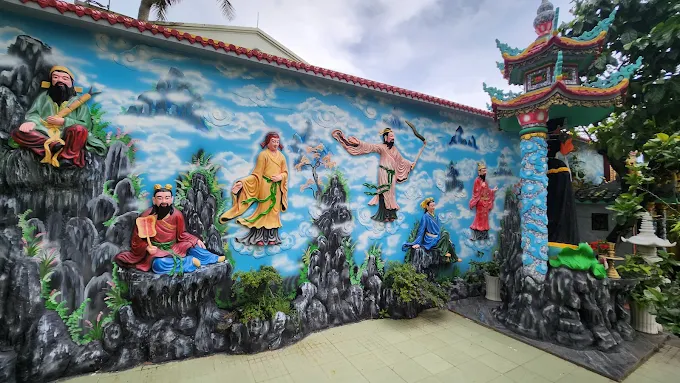
One of the most interesting artistic features at Dinh Ba is the collection of decorative wall panels and reliefs found around the building.
The images often include dragons, phoenixes, cranes, lotus flowers, mountain landscapes, clouds, and other symbols associated with good fortune and spiritual protection.
Some appear to be assembled from many small pieces of stone, ceramic, or colored material. This technique resembles the decorative mosaic work commonly seen in southern Vietnamese temples and some religious buildings in central Vietnam.
Viewed from a distance, the images appear bright and ornamental. Seen up close, they reveal considerable detail and craftsmanship. Because of these features, Dinh Ba can feel like a small museum of folk religious art hidden in the center of Duong Dong.
From a Simple Shrine to the Building Seen Today
Local accounts suggest that Dinh Ba was once far more modest than the structure visitors see today. The original shrine is said to have been built with wooden columns, simple walls, and a thatched roof. Over time, war, weather, and the growth of the local community led to repeated repairs and reconstructions.
Each restoration changed the appearance of the shrine while preserving its religious role. This explains why Dinh Ba does not look entirely ancient, despite the long history of the belief associated with it. The spiritual tradition may be old, while much of the current architecture reflects later periods of rebuilding.
Rather than reducing its value, this layered appearance tells another important story. It shows how local residents continued to care for the shrine and adapt it as Duong Dong changed around it.
Other Places Called Dinh Ba in Phu Quoc
Many visitors hear the name “Dinh Ba” and assume there is only one shrine with that name on the island. In reality, Phu Quoc has several places dedicated to different female deities or respected women. The shared title “Ba” does not mean that every shrine worships the same figure.
Understanding this difference is important because these shrines reflect distinct layers of local history and belief.
Dinh Ba in Ong Lang
Beside Dinh Ba in central Phu Quoc, There is another place called Dinh Ba either, but it located in Ong Lang. The Dinh Ba in the Ong Lang area is connected to a different figure known as Ba Lon Tuong Le Kim Dinh. According to local legend, she was the wife of national hero Nguyen Trung Truc. Stories about her remain especially strong in the Ong Lang and Cua Can areas.
One of the best-known legends concerns a bunch of golden bananas, although several versions of the story exist. Despite differences in detail, they usually portray Ba Lon Tuong as a generous and protective woman who supported local people during difficult times.
A grave in Cua Can is still identified by local residents as the tomb of Ba Lon Tuong. This shrine should not be confused with Dinh Ba Thuy Long Thanh Mau in Duong Dong, as the two places are associated with different figures and traditions.
Small Ba Shrines in Fishing Villages
Smaller shrines dedicated to female protective figures can also be found in fishing communities such as Ham Ninh, Cua Can, and An Thoi.
Some worship Thuy Long Thanh Mau, while others may be connected to Thien Hau Thanh Mau, local guardian spirits, historical women, or figures remembered as protectors of a particular village.
The name may be similar, but each shrine has its own story. Together, these places reveal how diverse spiritual traditions developed across Phu Quoc. Behind each small shrine is a mixture of local memory, migration, history, and belief.
How to Visit Dinh Ba
Dinh Ba is located on Vo Thi Sau Street in central Duong Dong, only a short walk from Dinh Cau. Many travelers visit Dinh Cau first and then continue to Dinh Ba. However, visiting in the morning provides a quieter and more local experience.
The shrine is easy to include in a walking route through central Duong Dong. Because it is an active place of worship, visitors should dress respectfully, speak quietly, and avoid disturbing people who are praying.
Photography is generally best approached with sensitivity. Avoid using flash near the altar, do not photograph worshippers without permission, and ask before filming inside during ceremonies.
A typical visit may take 20 to 30 minutes, although those interested in architecture may wish to spend longer examining the gates, roof decorations, columns, plaques, and wall mosaics.
A Suggested Cultural Walk Around Duong Dong
A relaxed morning route can begin at Bach Dang Park beside the Duong Dong River.
From there, walk toward Dinh Ba Thuy Long Thanh Mau and spend some time observing the shrine’s architecture. Continue to Sung Hung Pagoda, one of the oldest Buddhist temples on the island, before exploring Duong Dong Market.
You can then cross or walk toward Nguyen Trung Truc Bridge for views over the river and fishing boats.
In the late afternoon, return toward Dinh Cau to watch the sunset. Afterward, continue to Phu Quoc Night Market for dinner or try a local dish such as bun quay, fish noodle soup, or banh canh.
Within a few hours, this route brings together several parts of Duong Dong’s identity: folk belief, Buddhism, fishing life, markets, river scenery, and the modern tourism center.
Dinh Ba and the Spiritual Life of Phu Quoc
Phu Quoc is changing quickly. Luxury resorts, entertainment complexes, beach clubs, and modern attractions have transformed the island’s image. Yet small shrines such as Dinh Ba continue to preserve memories of the communities that existed long before tourism became the island’s main industry.
Dinh Ba Thuy Long Thanh Mau may not be a famous check-in point, and it may never attract the same crowds as Dinh Cau. Its importance lies elsewhere. And it is a place where residents still pray for their families, where festivals reconnect generations, and where the island’s relationship with the sea is expressed through faith.
It also reminds visitors that Phu Quoc is not only a destination of beaches and resorts. It is an island shaped by migration, fishing, uncertainty, gratitude, and the spiritual traditions of people who have lived beside the sea for generations.
Perhaps the small shrines are where the older soul of Phu Quoc is preserved most clearly.
They do not demand attention.
They simply remain, quietly carrying the stories of the island forward.
Leave a Reply